One sensor is not enough. Here’s what multi-modal data actually means, and why it’s becoming the foundation of modern robotics.
Close your eyes and try to make a cup of coffee. You could probably still do it. You know the weight of the mug, the click of the machine, the warmth of the water. That’s because you’re not relying on sight alone you’re fusing touch, sound, and memory into one continuous picture of what’s happening around you.
Robots need to learn the same trick, and that’s exactly the problem multi modal data is designed to solve.
What Is Multi Modal Data?
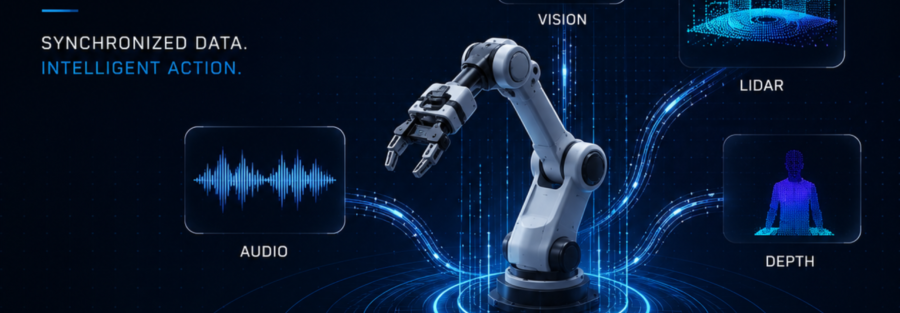
Multi-modal data is a training dataset that combines more than one sensory channel into a single, synchronized stream of information. Instead of feeding a model just camera footage, a multi-modal dataset typically brings together:
- Vision — RGB or stereo camera footage, the “eye” of the system
- Audio — microphone recordings capturing sound, the “ear”
- Touch — tactile and force sensor readings, the “hand”
- Depth — LiDAR, structured light, or stereo depth maps, the “ruler” that measures distance and shape
The key word here is combining. A multi-modal dataset doesn’t just store these signals side by side it time-aligns them so a model can learn how they relate to each other at the exact same moment. That distinction is what separates true multi-modal data from four separate, unrelated datasets.
Why Multi-Modal Data Matters for Robots
Most robotic systems today are still trained on a single type of data, usually vision. A camera feed goes in, a model learns to recognize objects and predict motion, and that’s the whole picture. This approach works in controlled environments, but it breaks down fast in the real world.
A robot trained only on visual data can’t tell the difference between a full glass and an empty one it’s about to knock over. It can’t feel that a jar lid is loose before it slips out of its grip. It can’t judge, from sound alone, whether a nearby machine is idling normally or about to fail. Vision is powerful, but it’s only one channel in a much richer signal, and robots that ignore the other channels are operating with blind spots baked into their training.
This is why multi-modal data has become such a critical focus in robotics research and deployment. Robots that are trained on multi-modal datasets learn to cross-reference sensory channels the way humans naturally do, which makes them dramatically more reliable outside of a lab setting.
How Multi-Modal Data Mimics Human Perception
Humans don’t process sight, sound, and touch in isolation. Our brains fuse them into a single coherent model of the world in real time. That fusion is what lets us react instantly when something feels off, sounds wrong, or looks different than expected, often before we’ve consciously registered a decision at all.
Multi-modal data training tries to give robots that same fused understanding. A robotic arm trained on multi-modal data doesn’t just see a glass sitting on a table. It correlates that visual information with the expected weight of the object, the sound of contact when fingers touch the surface, and the precise depth measurement needed to close its grip at exactly the right moment.
When one signal is ambiguous, such as a shadow that could be mistaken for an edge, or background noise that could be mistaken for a meaningful sound, the other channels in the multi-modal dataset fill in the gap. This redundancy is precisely what makes multi-modal data so valuable: it doesn’t just add information, it adds confidence.
Multi-Modal Data vs. Single-Sensor Training
It’s worth spelling out the difference clearly, because the gap in performance is significant:
Single-sensor training (vision only):
- Learns object recognition and basic motion prediction
- Struggles with ambiguous lighting, occlusion, or texture
- Cannot detect physical properties like weight, texture, or looseness
- Performs well in demos, unreliably in the real world
Multi-modal data training (vision + audio + touch + depth):
- Learns relationships between how something looks, sounds, and feels
- Cross-validates uncertain signals using other channels
- Captures physical properties invisible to a camera alone
- Performs consistently across unpredictable, real-world conditions
This is the core reason multi-modal data has moved from a research curiosity to an industry requirement. As robots move from controlled factory floors into homes, warehouses, and public spaces, the margin for sensory error shrinks, and multi-modal data is what closes that gap.
What Goes Into Building a Multi-Modal Dataset
Building a high-quality multi-modal dataset is far more complex than pointing a camera at a scene and hitting record. It requires:
- Synchronized hardware rigs that capture vision, audio, touch, and depth from the same physical event at the same instant
- Precise calibration across sensor types, since each modality captures data at different resolutions, frame rates, and formats
- Large-scale real-world interaction data, not just simulated or staged scenarios, so the resulting dataset reflects genuine physical variability
- Careful annotation and alignment, ensuring that a touch event, a sound, a depth reading, and a video frame all correspond to the same moment in time
The Business Case for Multi-Modal Data
Beyond the technical argument, there’s a practical one. Robots trained on multi-modal data require less manual correction, fail less often in unpredictable environments, and generalize better to new tasks without retraining from scratch. For companies deploying robots in logistics, manufacturing, healthcare, or home environments, that translates directly into lower operational costs and faster deployment timelines.
As multi-modal AI models become more capable, the bottleneck is shifting away from algorithms and toward data. The models can only be as good as the multi-modal datasets they’re trained on, which is why the quality and diversity of multi-modal data has become a competitive advantage in its own right.
How Nferent AI Builds Multi-Modal Data
At Nferent AI, we specialize in building multi-modal datasets specifically for training robots that need to operate in the physical world, not just recognize it, but understand and act within it. That means capturing vision, touch, audio, and depth together, at scale, with the precision and synchronization that real-world robotics demands.
We believe the future of robotics depends on multi-modal data that reflects how humans actually perceive the world: through multiple senses, working in concert, not in isolation.
Because a robot that can only see is only getting part of the story and in the real world, part of the story isn’t enough.