Ask any robotics engineer what keeps them up at night, and “perception” is usually near the top of the list. A robot can have the most sophisticated planning algorithm in the world, but if it misjudges the distance to a shelf, misses a person stepping out from behind a pallet, or fails to register a glass door, none of that intelligence matters. The physical world is unforgiving, and the sensors a robot uses to “see” that world determine whether it succeeds or fails.
At Nferent AI, we spend our days thinking about exactly this problem. As a multi-modal data collection company serving robotics and Physical AI teams across the United States, China, and South Korea, we’ve watched the debate over LiDAR versus cameras evolve from an either-or argument into something more nuanced” and more interesting. The short answer to “which sensor is best” is that it depends on what you’re asking the robot to do. The better answer is that robust Physical AI systems don’t choose one sensor over the other. They use both, and they use them together.
The Case for LiDAR: Depth You Can Trust
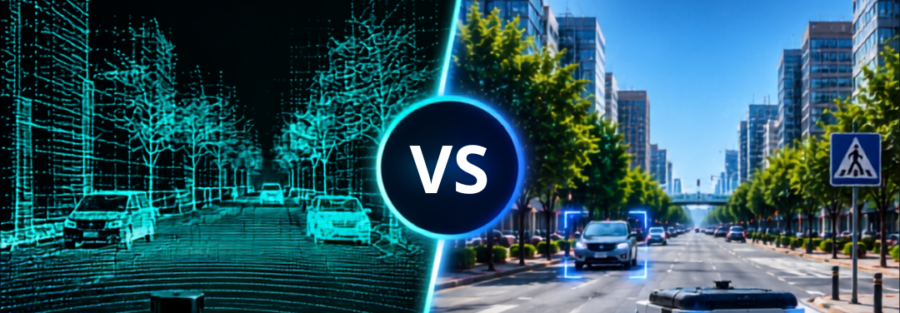
LiDAR (Light Detection and Ranging) works by firing pulses of laser light at the environment and measuring how long it takes for the light to bounce back. From that time-of-flight data, a LiDAR unit constructs a point cloud a three-dimensional map of every surface it can see, measured in centimeters of precision.
The appeal of LiDAR for robotics is straightforward: it gives you accurate, direct depth measurement without needing to infer anything. A camera has to guess how far away an object is based on visual cues, prior knowledge, and clever geometry. LiDAR simply measures it. This makes LiDAR extraordinarily good at:
- Operating in darkness. Because LiDAR generates its own light source, itdoesn’t care whether the room is pitch black or blindingly bright. A warehouse robot working a night shift or a delivery robot navigating a dim loading dock will still get a reliable 3D map of its surroundings.
- Precise obstacle avoidance. When a robot needs to know exactly how far it
is from a wall, a human, or another machine, LiDAR’s centimeter-level accuracy
is hard to beat. - Weather resilience. Automotive-grade LiDAR is engineered to perform
reasonably well through rain, fog, and glare conditions that can seriously
degrade camera performance.
But LiDAR has real limitations too. Point clouds are geometrically rich but semantically poor a LiDAR scan can tell you there’s a solid object two meters ahead, but it can’t tell you whether that object is a stop sign, a pedestrian, or a cardboard box blowing across a parking lot. LiDAR units are also historically more expensive than cameras, and they can struggle with certain reflective or transparent surfaces like glass and polished metal, which don’t return laser pulses in predictable ways.
The Case for Cameras: Context and Meaning
If LiDAR answers the question “where is it?”, cameras answer the question “what is it?” Vision sensors capture color, texture, and pattern the raw material that computer vision models use to classify objects, read text, recognize faces, and understand scenes in the way humans intuitively do.
Cameras bring several distinct advantages to robotic perception:
- Rich semantic understanding. A camera feed lets a model distinguish between a person and a mannequin, read a label on a box, or recognize a specific product on a shelf — tasks that are essentially impossible from geometry alone.
- Low cost and small form factor. Cameras are cheap, lightweight, and easy to integrate into almost any robotic platform, from a warehouse forklift to a palm-sized drone.
- Dense visual information. A single high-resolution image contains an enormous amount of information per pixel, which is invaluable for training the large vision models that increasingly power Physical AI systems.
The catch is that cameras are fundamentally passive sensors they depend on ambient light. In darkness, glare, or heavy shadow, a camera’s usefulness drops sharply. They also don’t measure depth directly; instead, they rely on techniques like stereo vision, structure-from-motion, or learned monocular depth estimation, all of which introduce uncertainty that compounds in safety-critical situations.
Why Robust Physical AI Needs Both
This is where the real lesson lives, and it’s one we’ve built our entire data collection methodology around at Nferent AI: LiDAR and cameras are not competitors they are complements. Each sensor covers the other’s blind spot.
Think of it this way: LiDAR tells a robot precisely where the world’s surfaces are, while cameras tell it what those surfaces mean. A warehouse robot equipped only with LiDAR might safely stop in front of an obstacle without ever knowing it just avoided a forklift versus a stack of empty boxes. A robot equipped only with cameras might correctly identify a person walking toward it but misjudge the exact distance in low light, with consequences that matter enormously at close range.
Sensor fusion the practice of combining LiDAR point clouds with camera imagery into a single, unified representation of the environment is quickly becoming the default architecture for serious Physical AI systems, from autonomous vehicles to humanoid robots to warehouse automation fleets. Fusion models can project camera pixels onto LiDAR points to create colorized, semantically labeled 3D maps. They can cross-check camera-based object detection against LiDAR-based depth to reduce false positives. And they provide redundancy: when one sensor’s data is degraded by darkness, by glare, by a temporary occlusion the other sensor’s data can carry the system through.
The catch with sensor fusion is that it’s only as good as the training data behind it. Fusion models need enormous volumes of synchronized, calibrated, multi-modal data LiDAR scans and camera frames captured at the same moment, from the same platform, across a huge diversity of environments, lighting conditions, and edge cases. Collecting that kind of data well is genuinely difficult. It requires careful sensor calibration, precise timestamp alignment, and rigorous quality control across enormous datasets and increasingly, it requires collecting that data across multiple countries and markets, since robots deployed in the U.S., China, and South Korea encounter meaningfully different environments, infrastructure, and regulatory standards.
Where Nferent AI Fits In
This is precisely the gap Nferent AI exists to close. We specialize in multi-modal sensor data collection for Physical AI teams, capturing synchronized LiDAR and camera data (along with other modalities as needed) across diverse real-world environments in the United States, China, and South Korea. Our teams handle the operational complexity of calibration, synchronization, labeling, and quality assurance so that robotics companies can focus on what they do best: building models.
The sensor debate isn’t really about choosing a winner. It’s about recognizing that depth without context is blind, and context without depth is uncertain. Robust Physical AI needs both and it needs training data that captures both, faithfully and at scale.
If your team is building perception systems that can’t afford to be blind-sided, that’s exactly the kind of multi-modal data Nferent AI is built to deliver.
Ready to see the difference multi-modal data makes? Get in touch with Nferent AI to learn how we can support your next Physical AI deployment.