Robots are only as capable as the data they learn from. As the robotics and embodied AI industry races toward general-purpose autonomy, one method has emerged as the gold standard for generating the rich, real-world data these systems need: teleoperation.
In this post, we’ll break down what teleoperation is, why it has become central to modern data collection pipelines, and how it’s shaping the next generation of robot learning.
What Is Teleoperation?
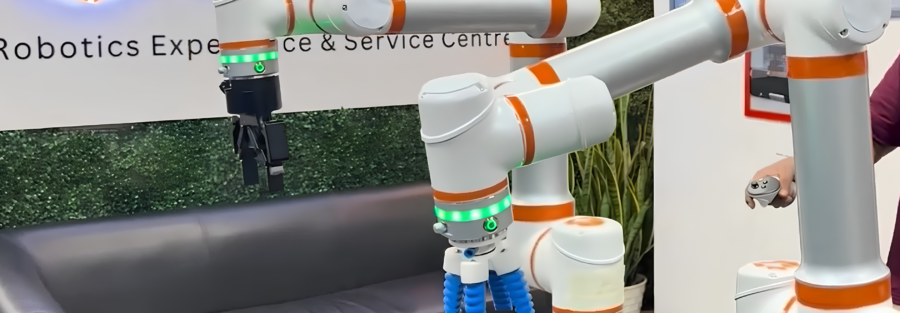
Teleoperation is the practice of remotely controlling a robot or machine through a human operator, using interfaces like joysticks, haptic gloves, VR headsets, motion-capture suits, or specialized control rigs. Instead of a robot acting autonomously, a person directly drives its movements arm trajectories, gripper actions, navigation, and more in real time.
While teleoperation has existed for decades in fields like bomb disposal, surgery, and space exploration, it has taken on a new role in AI: as a method for collecting demonstration data that trains robot learning models.
Why Teleoperation Matters for Data Collection
Modern robot learning approaches including imitation learning and reinforcement learning from demonstrations depend on large volumes of high-quality, labeled interaction data. Teleoperation solves several problems that other data sources can’t:
1. Real-World Grounding
Simulated data is useful, but it often fails to capture the messiness of the real world friction, lighting variation, deformable objects, unpredictable human interaction. Teleoperated data is collected on real hardware, in real environments, closing the “sim-to-real” gap.
2. Human Judgment Embedded in the Data
When a human operator performs a task say, folding a towel, sorting produce, or assembling a component — their decisions, timing, and dexterity are baked into every trajectory. This gives models exposure to nuanced, human-like problem solving that’s difficult to hand-code or simulate.
3. Scalable, Structured Diversity
By varying environments, objects, lighting, and task variations across many teleoperation sessions, data collection teams can systematically build diverse datasets something crucial for models that need to generalize.
4. Safety and Precision During Early Deployment
For tasks that are risky or expensive to get wrong (surgical robotics, hazardous materials handling, delicate manufacturing), teleoperation allows data collection without letting an untrained autonomous system make costly mistakes.
The Teleoperation Data Pipeline
A typical teleoperation-based data collection workflow looks like this:
- Task Design — Define the specific skill or behavior to capture (e.g., pick-and-place, insertion, navigation).
- Operator Setup — Human operators use control interfaces to pilot the robot through the task.
- Multi-Modal Recording — Synchronized capture of camera feeds, joint states, force/torque sensors, and operator inputs.
- Annotation & QA — Trajectories are labeled, validated, and filtered for quality, consistency, and edge cases.
- Dataset Packaging — Data is structured into training-ready formats for imitation learning, reinforcement learning, or foundation model fine-tuning.
Each stage matters. Poorly synchronized sensors or inconsistent labeling can quietly degrade downstream model performance which is why quality control is as important as data volume.
Common Use Cases
- Robotic manipulation — grasping, assembly, packaging, and warehouse operations
- Autonomous vehicles — edge-case driving scenarios and safety-critical maneuvers
- Humanoid robotics — whole-body coordination, locomotion, and dexterous manipulation
- Surgical and medical robotics — precision procedures requiring expert human input
- Agriculture and field robotics — harvesting, sorting, and terrain navigation in unstructured environments
Challenges Worth Solving For
Teleoperation isn’t without friction. Companies building data pipelines around it need to account for:
- Operator training and consistency — different operators may perform tasks differently, introducing variance
- Latency and control fidelity — especially for remote or cloud-based teleoperation setups
- Hardware calibration — sensor drift or misalignment can introduce silent data quality issues
- Cost and scalability — human-in-the-loop collection is more resource-intensive than passive data scraping
This is exactly where a dedicated data collection partner adds value building the infrastructure, operator networks, and QA pipelines needed to produce teleoperation datasets that are clean, diverse, and ready for training at scale.
Looking Ahead
As robotics companies push toward more general-purpose, adaptable systems, the demand for high-fidelity teleoperation data is only growing. The next frontier includes:
- Hybrid autonomy-teleoperation systems, where robots handle routine tasks and hand off to human operators for edge cases
- Cross-embodiment datasets, where teleoperated demonstrations from one robot platform help train models for different hardware
- Richer sensory capture, including tactile and force feedback, to teach robots more subtle physical skills
Teleoperation isn’t just a stopgap until robots are “smart enough.” It’s becoming a foundational data infrastructure layer for embodied AI much like labeled image datasets were for computer vision.
Frequently Asked Questions
- What is teleoperation in robotics? Teleoperation is the remote control of a robot by a human operator using interfaces like joysticks, VR headsets, haptic gloves, or motion-capture rigs. The operator directly drives the robot’s movements in real time, rather than the robot acting autonomously.
- Why is teleoperation used for AI data collection? Teleoperation lets companies capture real-world, human-guided demonstrations of tasks such as grasping, sorting, or assembly which are used to train robot learning models through imitation learning and reinforcement learning. This produces data that’s more realistic and nuanced than purely simulated data.
- What’s the difference between teleoperation data and simulated data? Simulated data is generated in virtual environments and is fast and cheap to produce, but often misses real-world variables like friction, lighting, and unpredictable object behavior. Teleoperated data is collected on physical robots in real environments, which helps close the “sim-to-real” gap.
- What kind of data is captured during teleoperation? A typical session records synchronized data streams including camera feeds, robot joint states, force/torque sensor readings, and the operator’s control inputs. Together, these create a full picture of how a task was performed.
- What industries use teleoperation for data collection? Common applications include robotic manipulation and warehouse automation, autonomous vehicles, humanoid robotics, surgical and medical robotics, and agricultural or field robotics.
- What are the biggest challenges in teleoperation-based data collection? Key challenges include maintaining consistency across different human operators, minimizing control latency, keeping hardware and sensors properly calibrated, and managing the cost of human-in-the-loop data collection at scale.
- Is teleoperation still relevant as robots become more autonomous? Yes. Even as autonomy improves, teleoperation remains valuable for handling edge cases, training on rare or high-risk scenarios, and generating the high-quality demonstration data that autonomous systems are built on. Many companies now use hybrid systems where robots operate autonomously most of the time but hand off to a human teleoperator for difficult situations.
- How can a data collection company help with teleoperation data? A dedicated partner can provide trained operator networks, calibrated hardware setups, synchronized multi-modal recording, and quality assurance pipelines turning raw teleoperation sessions into clean, structured datasets that are ready for model training.