
Walk into a warehouse, a hospital, or even a living room in 2026, and there’s a good chance you’ll spot one: a humanoid robot, standing upright, arms swinging, cameras scanning the room. Tesla’s Optimus is folding laundry in demo videos. Boston Dynamics’ Atlas is doing backflips and bin-picking. Figure’s Figure 01 is shaking hands with factory workers. The hardware race is real, and it’s moving fast.
But here’s the uncomfortable truth the headlines rarely mention: a humanoid robot with perfect motors, flawless actuators, and a beautiful aluminum chassis is still just an expensive statue without the right data behind it. Hardware is only half the story. The other half the half that actually decides whether a robot can grasp a coffee cup without crushing it, walk across an uneven hospital floor, or hand a tool to a surgeon at the right angle is training data.
This is the gap Nferent AI exists to close.
Humanoid Robot Training Data Is Why Hardware Alone Gets Robots Stuck at 50%
Building a humanoid robot body has become almost a solved engineering problem. Companies can now source high-torque actuators, dexterous hands, and lightweight frames, and assemble something that looks convincingly human. What they can’t source off the shelf is the intelligence that makes that body useful.
Robots don’t learn to move the way humans do by falling off a bike a dozen times and adjusting. They learn from data: thousands of hours of motion capture, grasp attempts, force feedback, and sensor recordings that teach a model what “picking up a glass” or “climbing a step” actually looks like in every possible variation. Without this, even the most advanced humanoid robot behaves like a brilliant brain with no memories capable of computation, but clueless about the physical world.
This is why so many demo videos feel impressive but oddly narrow. A robot that folds one specific shirt in one specific lighting condition isn’t intelligent it’s memorized. Real-world deployment in factories, homes, and hospitals demands something far harder: robots that can generalize, adapt, and recover from the unexpected. That only comes from rich, diverse, high-quality training data.
Humanoid Robot Training Data Needs Change Across Factories, Homes, and Hospitals Factories
In manufacturing, humanoid robots need to handle variable parts, shifting production lines, and split-second coordination with human coworkers. The training data here has to capture fine motor precision: grasping irregular objects, adjusting grip force in real time, and adapting to tools that change from one shift to the next.
- Homes: Domestic environments are messier and far less predictable than any factory floor. A robot assisting in a home needs data on navigating clutter, handling fragile objects, and responding to unpredictable human movement a toddler running past, a pet underfoot, a spilled drink. This is a data problem orders of magnitude harder than industrial automation.
- Hospitals: Healthcare is the highest-stakes frontier. Robots assisting nurses or supporting patients need training data reflecting careful, controlled movement, sanitary handling protocols, and an ability to recognize when a human is in distress. There is zero tolerance for error, which means the underlying data must be exceptionally precise and well-labeled.
Across all three environments, one pattern holds: the hardware whether it resembles Optimus, Atlas, or Figure 01 is converging toward similar capability. What separates a robot that actually works from one that stays in the lab is the depth and quality of the data teaching it how to move, grasp, and adapt.
Humanoid Robot Training Data Explained: What It Actually Includes
When people hear “training data,” they often picture spreadsheets or labeled images. For humanoid robots, it’s far richer and more physical. It typically includes:
- Motion capture and teleoperation data — recordings of human demonstrators performing tasks, which robots learn to imitate
- Grasp and manipulation datasets — thousands of examples of hands interacting with different object shapes, weights, and textures
- Simulation-to-reality data — synthetic environments that generate huge volumes of training scenarios before real-world testing
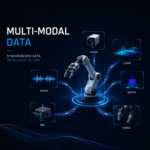
- Sensor fusion data — combined vision, force, and proprioceptive signals that teach a robot to “feel” its environment, not just see it
- Edge-case and failure data — the moments a robot slips, misjudges a grip, or loses balance, which are often more valuable for learning than perfect repetitions
The companies that win the humanoid robotics race won’t necessarily be the ones with the best actuators. They’ll be the ones with the best pipelines for generating, curating, and refining this kind of data at scale.
Humanoid Robot Training Data Is Nferent AI’s Focus Solving the Other 50%
This is exactly where Nferent AI comes in. While much of the industry has focused on hardware, Nferent AI is focused on the layer underneath it the training data infrastructure that turns a humanoid robot from a impressive machine into a genuinely capable one.
Nferent AI works on the data pipelines that teach robots how to move naturally, grasp objects with human-like dexterity, and adapt to environments they’ve never seen before. Instead of narrow, single-task demonstrations, the goal is building diverse, high-fidelity datasets that generalize across factories, homes, and hospitals the exact three frontiers humanoid robots are entering right now.
For robotics companies building the next Optimus, Atlas, or Figure 01 competitor, this matters enormously. A humanoid robot is only as good as the data behind its movement models. Get the data wrong, and even the best hardware stalls out in expensive, brittle demos. Get it right, and a robot can walk into a genuinely unpredictable environment a cluttered kitchen, a busy hospital corridor, a factory floor mid-shift-change and still perform reliably.
Humanoid Robot Training Data Will Take the Industry Further Than Hardware Ever Could
The past few years have proven that humanoid robot hardware is no longer the limiting factor. Optimus, Atlas, and Figure 01 have shown the world that human-like bodies capable of walking, balancing, and manipulating objects are achievable engineering feats.
But the next chapter of humanoid robotics won’t be won on the factory floor where these machines are assembled. It will be won in the training pipelines that teach them how to behave once they’re out in the real world moving through homes, working alongside factory teams, and supporting patients in hospitals.
That’s the problem Nferent AI is built to solve: not just building smarter robots, but building the data that makes them truly capable.
Want to see how Nferent AI is closing the data gap for humanoid robotics? Visit nferent.ai to learn more about our training data solutions for the next generation of humanoid robots.