Imagine two robot arms doing the exact same job picking, placing, sorting, assembling. One of them nails the task almost every single time. The other one fumbles, drops things, and misreads its environment. Same hardware. Same motors. Same basic design. So what’s actually different?
The answer is not the robot. It’s the robot arm training data behind it.
In the world of physical AI, everyone talks about better sensors, faster processors, and smarter algorithms. But the real game-changer is often invisible it’s the quality of the data used to teach the robot how to move, grip, adjust, and react in the real world. And the numbers prove it.
The Real Test: Before vs After Robot Arm Training Data
Let’s look at an actual comparison that shows exactly how much training data matters.
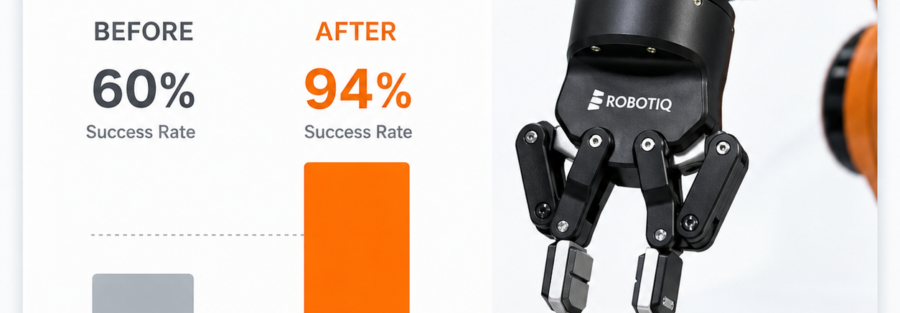
Before high-quality data: A robot arm trained on standard or limited data achieved only a 60% task success rate. That means nearly 4 out of every 10 attempts failed a dropped object, a missed grip, a misjudged angle, or a task left incomplete.
After high-quality robot arm training data: The same robot, trained on rich, diverse, real-world, multi-modal data, jumped to a 94% task success rate. That’s not a small improvement that’s the difference between a robot you can trust in production and one that constantly needs human correction.
This single case study tells a bigger story: the hardware wasn’t the bottleneck. The data was.
This is where Nferent AI comes in. Nferent AI specializes in collecting and structuring exactly this kind of high-quality physical AI data diverse, real-world, multi-modal datasets built specifically for robot arm training. Instead of relying on limited or purely simulated data, Nferent AI captures real-world interactions across varied objects, environments, and conditions, then structures that data in a way robotic systems can actually learn from effectively. The 60% to 94% success rate jump isn’t a hypothetical it’s the kind of result Nferent AI’s approach to physical AI data is designed to deliver.
Why Robot Arm Training Data Makes Such a Big Difference
Most people assume robots learn like humans through instinct or trial and error alone. In reality, every movement a robot arm makes is shaped by the data it was trained on. If that data is narrow, repetitive, or unrealistic, the robot will struggle the moment it faces something slightly different from what it “practiced.”
Here’s what actually separates weak training data from strong robot arm training data:
1. Diversity of Scenarios
A robot trained only on one type of object, lighting condition, or workspace layout will fail the moment conditions change. High-quality training data includes multiple object shapes, sizes, textures, and environments so the robot learns to generalize instead of memorize.
2. Real-World Data, Not Just Simulations
Simulated environments are useful, but they don’t capture the unpredictability of the real world friction, lighting shifts, slight human errors, and physical randomness. Robot arm training data collected from real-world interactions teaches the robot to handle situations it will genuinely face on the job.
3. Multi-Modal Data Inputs
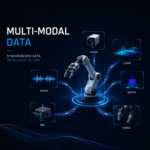
Modern robotic systems don’t rely on vision alone. They combine visual data, force feedback, depth sensing, and motion tracking. Multi-modal robot arm training data allows the robot to “understand” a task the way a human would using multiple senses together, not just one.
4. Volume and Consistency
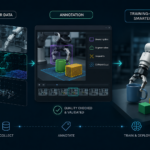
It’s not just about having a lot of data it’s about having the right kind of data, consistently labeled and structured, so the AI model can actually learn meaningful patterns instead of noise.
How Better Robot Arm Training Data Improves Real Performance
When robot arm training data is built the right way, the results show up in very practical ways:
- Higher task success rates — like the jump from 60% to 94% seen in real testing
- Fewer failed grips and dropped items — because the robot has “seen” similar variations before
- Better adaptability — the robot performs well even in slightly new or unexpected conditions
- Reduced need for manual correction — less downtime, more autonomous operation
- Faster deployment in production environments — since the robot doesn’t need constant retraining
This is exactly why companies working on physical AI are shifting their focus. It’s no longer just about building a better robot it’s about feeding that robot better data.
Physical AI Is Only as Good as Its Data
There’s a simple truth in robotics right now: even the most advanced robot arm is only as capable as the data it learns from. You can have cutting-edge motors, precise sensors, and a powerful AI model but if the training data is weak, performance will always hit a ceiling.
That’s the real lesson behind the 60% to 94% improvement. It wasn’t a hardware upgrade. It wasn’t a new algorithm. It was better robot arm training data diverse, real-world, multi-modal, and built for how robots actually operate outside a lab.
As physical AI continues to grow across industries like manufacturing, logistics, healthcare, and warehousing, the companies that win will be the ones who understand this early: data quality is not a side detail, it’s the foundation.
Final Thoughts
If you’re building or scaling a physical AI system, the question to ask isn’t “How do we make the robot smarter?” It’s “How do we make our robot arm training data better?”
Because as this real-world comparison shows, that one shift from average data to high-quality, diverse, real-world, multi-modal data can take a robot from unreliable to nearly flawless.
This is exactly the gap Nferent AI helps close turning raw, real-world physical interactions into structured, multi-modal training data that gives robot arms the depth of experience they need to perform reliably, not just in a lab, but in real production environments.
Curious how Nferent AI’s high-quality robot arm training data could improve your own systems? Ask us how