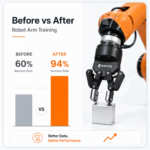
Robots don’t learn the way humans do. A child touches a hot stove once and remembers forever. A robot needs thousands, sometimes millions, of labeled examples before it can reliably tell the difference between a coffee cup and a doorknob, or a person and a pallet. That labeling process is called data annotation, and it is the single most important and most overlooked step in building physical AI systems.
If you’ve ever wondered why two robots trained on seemingly similar data perform so differently in the real world, the answer almost always comes down to annotation quality. This post breaks down what data annotation for robotics actually is, why it matters so much, and how the process works from raw sensor feed to a model that’s ready to deploy.
Why Raw Sensor Data Alone Isn’t Enough
Every robot, whether it’s a warehouse picker, a delivery bot, or a humanoid, is constantly collecting data from cameras, LiDAR, depth sensors, IMUs, and force-torque sensors. On its own, this data is just noise to a machine learning model. A stream of pixel values or point clouds doesn’t tell an algorithm “this is a human hand” or “this is a fragile object” or “this surface is slippery.”
Raw data has to be transformed into structured, meaningful information before a model can learn from it. That transformation is annotation: the process of attaching labels, boundaries, categories, or semantic meaning to raw sensor inputs so a machine learning model can recognize patterns and make decisions.
Without this step, even the most advanced sensors and the most powerful GPUs produce nothing usable. Annotation is the bridge between data collection and model training, and skipping it or doing it poorly is the number one reason robotics AI projects stall.
What Data Annotation Actually Involves
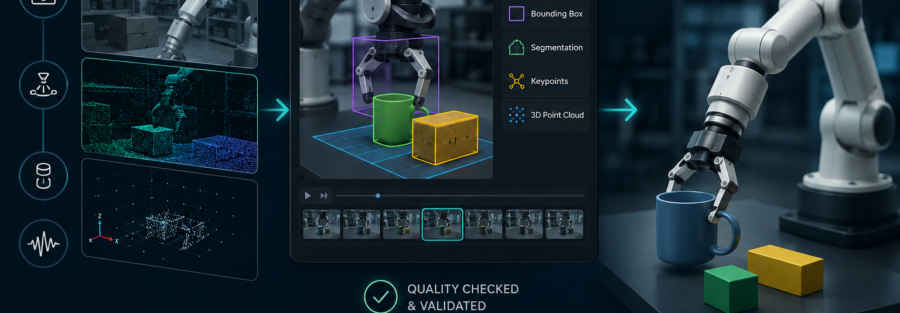
Data annotation for robotics is more complex than tagging photos for a social media app. Robots operate in three-dimensional, dynamic, physical environments, which means annotation has to capture far more nuance. Common annotation types include:
- 2D bounding boxes and segmentation – outlining objects in camera images so a model can detect and classify them.
- 3D point cloud labeling – annotating LiDAR or depth-sensor data to help robots understand distance, volume, and spatial layout.
- Pose and keypoint annotation – marking joints, grip points, or orientation so a robot arm knows how to approach and manipulate an object.
- Semantic and instance segmentation – distinguishing not just “this is a box” but “this specific box, separate from the one next to it.”
- Action and event labeling – tagging sequences of movement, such as a human walking into a robot’s path, so models learn to predict behavior over time.
- Sensor fusion annotation – aligning labels across camera, LiDAR, and other sensors simultaneously, since robots rarely rely on a single data source.
Each of these annotation types requires different tools, different expertise, and different quality checks. A model trained for grasping needs precise keypoint and pose data. A model trained for navigation needs accurate spatial and object-boundary data. Getting the annotation type wrong, or getting it right but inconsistent, directly caps how well the resulting model can perform.
The Annotation Workflow, Step by Step
While specifics vary by use case, most robotics annotation pipelines follow a similar structure:
- Data ingestion – Raw sensor recordings from cameras, LiDAR, and other sources are collected and organized into structured batches.
- Task definition – Annotation guidelines are written to define exactly what needs to be labeled, how edge cases should be handled, and what accuracy standard is required.
- Annotation – Human annotators, often supported by AI-assisted labeling tools, tag the data according to the defined task. For robotics, this frequently mixes automated pre-labeling with human review, since fully manual labeling of 3D point clouds or long video sequences is slow and expensive.
- Quality assurance – Labeled data is checked against the guidelines, with disagreements resolved and inconsistent labels corrected. This step is where most annotation vendors cut corners, and it’s where dataset quality is actually won or lost.
- Validation against the model – The dataset is tested against a baseline model to confirm the labels actually improve performance, not just look correct on paper.
- Delivery – The final, structured dataset is packaged in a format ready for model training pipelines.
Done properly, this workflow turns disorganized sensor recordings into a dataset a machine learning engineer can plug directly into training without weeks of cleanup.
Why Annotation Quality Is the Real Bottleneck
Most teams underestimate how much annotation quality affects downstream performance. A model is only ever as good as the labels it was trained on. If bounding boxes are inconsistent by even a few pixels across thousands of images, or if keypoints are mislabeled on a fraction of grasping examples, the model inherits that noise and reproduces it as unreliable behavior in the real world.
This is especially true in robotics because physical mistakes have physical consequences. A vision model that occasionally misclassifies a cat photo is a minor inconvenience. A robot that misjudges the edge of a shelf, or fails to recognize a person entering its workspace, is a safety issue. That’s why annotation for robotics demands tighter tolerances, more rigorous QA, and annotators who understand the physical context of what they’re labeling, not just generic image tagging experience.
The Overlooked Step Companies Keep Getting Wrong
Data collection tends to get the spotlight. Companies invest heavily in sensor rigs, data collection fleets, and simulation environments, then treat annotation as an afterthought something to outsource cheaply and quickly. The result is often datasets that look complete but are functionally unusable: inconsistent labeling standards, mismatched formats between sensors, or annotation vendors with no robotics-specific expertise.
This disconnect between collection and annotation creates friction. Data gets handed off between teams or vendors, standards get lost in translation, and engineering teams end up spending more time cleaning and re-labeling data than actually training models.
How Nferent AI Approaches Annotation
At Nferent AI, we treat data collection and annotation as one continuous pipeline, not two separate handoffs. We handle end-to-end: collecting raw sensor data and annotating it under the same quality standards, using annotators who understand the physical and spatial context robotics data demands.
The flow looks like this:
Raw sensor data → Annotation layer → Clean, structured dataset
Because we own the entire process, there’s no gap where quality gets lost between collection and labeling. What lands in your training pipeline is ready to use immediately, without weeks of reformatting, relabeling, or quality audits on our end.
Annotation isn’t a side task in building physical AI 0it’s the step that determines whether your model actually works. Raw data collection gets you inputs. Annotation is what turns those inputs into something a model can learn from, and the quality of that annotation directly caps the quality of everything you build on top of it.
If you’re building robotics AI and finding that your models underperform despite good sensor coverage, the annotation layer is the first place to look.
Want datasets that go from raw sensor data to training-ready without the usual back-and-forth? Talk to Nferent AI about end-to-end data collection and annotation for your next robotics project