Robots are becoming increasingly capable of performing complex tasks across industries, from manufacturing and warehousing to logistics and healthcare. However, teaching robots to perform real world tasks accurately and consistently remains a major challenge.
This is where teleoperation data collection for robotics plays an important role. By allowing humans to remotely control robots and demonstrate tasks, teleoperation helps collect valuable real-world data that can be used to train intelligent robotic systems.
At Nferent.ai, we recognize the importance of high-quality robotics data in developing smarter, more adaptable, and efficient automation solutions.
What Is Teleoperation Data Collection in Robotics?
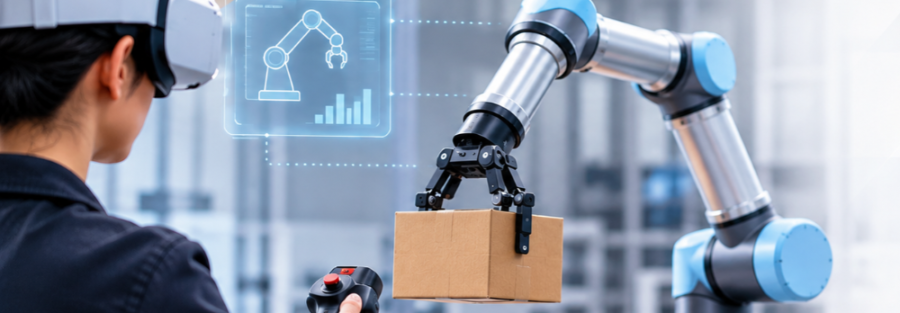
Teleoperation is a process in which a human operator remotely controls a robot to perform specific tasks. The robot follows the operator’s movements and actions while recording important information such as joint positions, movements, camera feeds, force feedback, and task interactions.
This recorded information becomes training data for robotics and AI models.
Unlike traditional programming, where robots follow predefined instructions, teleoperation allows robots to learn from human demonstrations. It helps capture how tasks are performed in real world environments, including situations involving changing objects, unexpected movements, and complex interactions.
Why Is Teleoperation Important for Robot Training?
Training robots to operate independently requires large amounts of accurate and diverse data. Simulated environments can provide useful training scenarios, but real world demonstrations are essential for understanding physical interactions.
Here are some key benefits of teleoperation data collection:
1. Learning from Human Demonstrations
Human operators demonstrate how to perform tasks, allowing robots to learn complex movements and actions. This data can support imitation learning and other robot learning approaches.
2. Handling Real-World Variations
Real world environments are unpredictable. Objects may have different shapes, sizes, textures, and positions. Teleoperation helps capture these variations and provides diverse examples for robot training.
3. Improving Task Accuracy
Repeated human demonstrations help generate training datasets that can improve robotic task execution, movement coordination, and object manipulation.
4. Supporting Advanced Robotics Models
High quality teleoperation datasets can support the development of vision language action (VLA) models, imitation learning systems, and autonomous robotic applications.
How Does Teleoperation Data Collection Work?
The teleoperation data collection process generally involves several stages:
Step 1: Remote Robot Control
A human operator controls a robot using a teleoperation interface, such as a joystick, motion tracking system, or specialized control device.
Step 2: Task Demonstration
The operator guides the robot through specific activities, including picking, placing, sorting, assembling, or manipulating objects.
Step 3: Data Recording
During each demonstration, the system captures relevant information, including:
- Robot joint positions and movements
- Camera and visual observations
- End effector movements
- Object interactions
- Force and tactile feedback, where available
- Task execution timestamps
Step 4: Data Processing and Annotation
Collected data is reviewed, organized, and processed to ensure consistency and usability. Relevant task labels and annotations can help make datasets suitable for model training.
Step 5: Model Training and Evaluation
The prepared dataset can be used to train and evaluate robotic learning models, helping robots improve their ability to perform tasks with greater independence.
Applications of Teleoperation Data Collection
Teleoperation is useful across multiple robotics applications where physical interaction and adaptability are important.
- Warehouse Automation: Training robots for picking, packing, sorting, and material handling.
- Manufacturing: Collecting demonstrations for assembly, component handling, and precision operations.
- Humanoid Robotics: Teaching humanoid robots to perform human like movements and everyday activities.
- Logistics: Supporting robotic systems that handle different objects and dynamic working environments.
- Research and Development: Creating datasets for imitation learning, robot manipulation, and embodied AI research.
Challenges in Teleoperation Data Collection
Despite its advantages, collecting effective robotics data comes with several challenges.
- Data Quality: Inaccurate demonstrations, missing information, and inconsistent recordings can affect model performance.
- Task Diversity: Robots need exposure to different environments, objects, and scenarios to improve generalization.
- Human Operator Consistency: Different operators may perform the same task differently, making standardized data collection important.
- Scalability: Collecting large volumes of high quality demonstrations requires efficient workflows, reliable equipment, and proper data management.
Addressing these challenges is essential for building reliable robotic learning systems.
The Future of Robotics Starts with Better Data
As robotics and embodied AI continue to evolve, the importance of high quality real world training data will only increase.
Teleoperation data collection provides a practical way to transfer human skills into robotic systems. By combining human demonstrations, structured data collection, and advanced AI training techniques, robotics developers can build systems that better understand and interact with the physical world.
At Nferent.ai, we believe that quality data is a fundamental building block of intelligent automation. Enabling robots to learn from real world demonstrations is an important step towards more capable, adaptable, and autonomous robotic systems.
Building smarter robots starts with better data. Explore how Nferent.ai can support the future of robotics and AI.