Robots are getting better at seeing and planning, but one problem still holds them back: data. To learn a skill like folding a cloth or placing a cup on a saucer, a robot needs hundreds or thousands of good human demonstrations. Collecting them is slow, expensive, and usually limited to a lab.
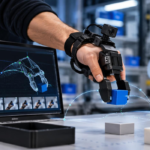
The Universal Manipulation Interface (UMI) is a clever answer to this problem. Instead of controlling a robot to collect data, you pick up a handheld gripper, do the task yourself, and the recording becomes training data for a robot. In this post, I’ll explain how the UMI gripper data collection workflow works and why it matters.
The core idea is simple: separate data collection from robot hardware. Traditionally, teleoperation meant that to collect data for a robot, you needed that robot, plus a leader device, plus a lab. UMI removes that dependency. The only hardware you need is a lightweight, handheld, 3D-printable gripper.
The Hardware
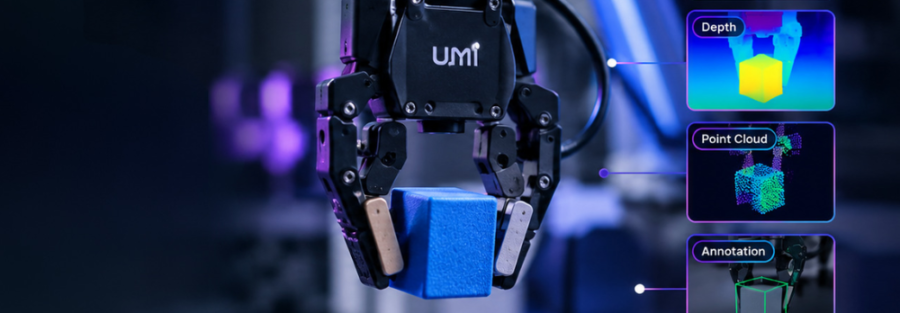
The UMI gripper is deliberately minimal:
- A GoPro camera mounted on the gripper, with a fisheye lens that gives a very wide field of view. This is the robot’s “eye” during both data collection and deployment.
- Soft, compliant fingers that let the operator grasp objects naturally and give the policy useful information about how wide the gripper is open.
- Side mirrors that give the camera an implicit stereo view, helping with depth perception.
- Fiducial markers on the fingers so the camera can track the gripper’s opening width.
Because the camera is on the gripper itself, what the human sees through the lens is almost exactly what the robot will see later. This shared viewpoint is what makes the data transferable.
The Data Collection Workflow
Here is how a typical session looks.
1. Perform the task. The operator holds the gripper and performs the task, such as arranging cups, washing a dish, or tossing an object. No robot is involved, so this can happen in a kitchen, an office, or outdoors.
2. Record everything. The GoPro captures video along with IMU (motion sensor) data.
3. Estimate the pose. After the session, a visual-inertial SLAM pipeline (based on ORB-SLAM3) processes the video and IMU data to recover the gripper’s 6-DoF pose, meaning its position and orientation in space over time.
4. Track the gripper width. The fiducial markers on the fingers are tracked to estimate how open or closed the gripper is at every moment.
5. Build the dataset. The result is a synchronized set of observations (camera images) and actions (gripper poses and widths), exactly what a learning algorithm needs.
Many operators can collect data in many different locations, which is what gives the dataset real diversity.
Why UMI Is Different
Compared with other approaches, UMI has some clear advantages:
- Low cost and portable. No robot arm, motion-capture room, or VR setup is required.
- Diverse “in-the-wild” data. Because collection happens anywhere, policies see varied backgrounds, lighting, and objects, which helps them generalize.
- Rich visual context. The wide fisheye view gives the policy more of the scene than a narrow camera would.
- Hardware agnostic. The data is not tied to one specific robot.
From Demonstrations to Robot Policies
Once the data is collected, a policy is trained on it, in the original work using Diffusion Policy, a method that generates actions by gradually denoising random noise into a plausible trajectory.
Two design choices make deployment smoother:
- Relative trajectory representation. Actions are expressed relative to the gripper’s current pose rather than in a fixed world frame. This lets the same policy work across different robot arms.
- Latency matching. Real robots have delays in sensing and control. UMI accounts for this so the policy’s actions line up with what the robot can actually execute.
In the paper, policies trained purely on handheld data were deployed on robot arms such as the UR5 and Franka. They handled tasks including cup arrangement, dynamic tossing, bimanual cloth folding, and dish washing. Notably, policies trained on diverse data could work in environments they had never seen before.
Limitations and Challenges
UMI is powerful, but it is not magic.
- SLAM can fail in scenes with few visual features or lots of motion, which affects pose quality.
- Embodiment limits. The human must work within what the robot gripper can physically do, so tasks are limited to those a parallel-jaw gripper can perform.
- No tactile feedback. The system relies on vision and gripper width, not a true sense of touch.
- Operator skill matters. Smooth, consistent demonstrations produce better policies, and some practice is needed to use the tool well.
Why It Matters
Robot learning is increasingly limited by data, not algorithms. Language and vision models benefited from the internet’s huge supply of text and images, but robotics has no equivalent. UMI points toward a way to scale: cheap, portable, open hardware that many people can use to collect demonstrations in the real world.
The design is also open, which has helped researchers and hobbyists build on it and extend it. For anyone interested in robot learning, UMI is an excellent starting point for understanding how modern, data driven manipulation works.
How Nferent AI Collects Data
UMI is not just a research idea. Companies are now using this handheld approach to build real world robot datasets, and Nferent AI is one of them. Nferent AI collects UMI data: operators use handheld grippers to perform tasks, and those demonstrations are turned into training data for robot manipulation policies.
This is exactly the strength of the UMI workflow in action. Because collection needs no robot, it can be done in many settings by many operators, which gives the dataset the diversity that policies need to generalize.
For anyone following the field, this shows where robot learning is heading: a growing ecosystem of teams collecting real world demonstrations with handheld interfaces, rather than relying only on lab based teleoperation.