Every capable robot manipulation policy running today learned its skills from somewhere, and increasingly, that somewhere is a human sitting at a control rig, moving a robot arm by hand. Teleoperation data collection is the process of capturing exactly that: a human operator directly controlling a physical robot to perform a task, while every sensor reading and every action the robot takes is recorded as training data. It remains the gold standard for teaching robots to manipulate the physical world, and understanding how it works and where its limits are is essential for anyone building or evaluating embodied AI systems in 2026.
What Is Teleoperation Data Collection?
At its core, teleoperation data collection captures state-action pairs: what the robot’s sensors observed at a given moment, and what action the human operator commanded in response. Because the human is controlling the actual robot rather than a stand-in device, the resulting data lives natively in the robot’s own action space. A policy trained on this data doesn’t need to translate or infer anything It can consume the recorded state action pairs directly, which is a major reason teleoperated demonstrations tend to produce such high-quality data for robot learning, since the state action pairs it generates are consumed by imitation learning algorithms without additional inference.
This distinguishes teleoperation from two other common data sources in robot learning: simulation, which generates synthetic experience at scale but suffers from a reality gap when transferred to physical hardware, and passive human video, which is abundant and diverse but carries no explicit robot action labels at all.
Common Teleoperation Hardware Interfaces
Several interface types dominate current teleoperation data collection pipelines, each with its own tradeoffs in cost, precision, and operator training time:
Leader-follower arm systems. Setups like ALOHA use a pair of low-cost “leader” arms that an operator moves by hand, while matched “follower” arms on the robot replicate the motion in real time. This approach has become popular in academic and open-source robotics because it’s relatively affordable and intuitive for operators to learn.
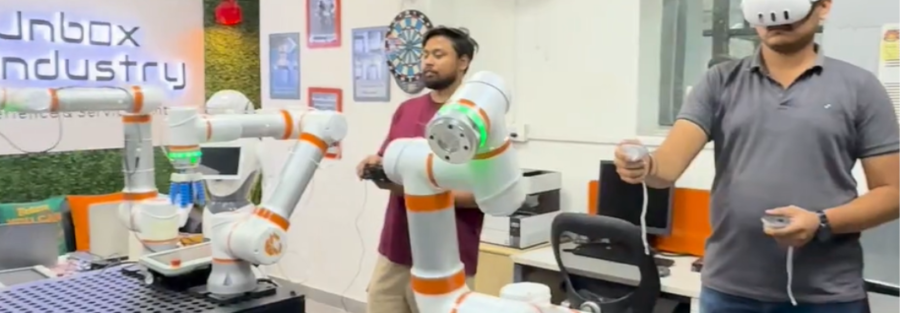
VR and motion-controller interfaces. Virtual reality headsets paired with handheld controllers let an operator see through the robot’s cameras and control its end-effector with natural hand movements, often at lower hardware cost than a full leader arm rig.
Exoskeleton interfaces. Wearable exoskeletons capture an operator’s full arm and hand kinematics with high fidelity, and are especially useful for dexterous, contact rich manipulation tasks where subtle finger and wrist movements matter.
3D SpaceMouse and joystick controllers. Simpler input devices that trade some naturalness of control for lower cost and faster deployment across many collection stations.
Bilateral and haptic-feedback systems. More advanced rigs give the operator force feedback from the robot’s contact with the environment, improving precision on tasks that require delicate touch an approach companies like Sanctuary AI have paired with tactile sensors on humanoid hands to generate richer, touch-aware training data.
The choice of interface directly shapes both data quality and collection throughput, so most production pipelines standardize around one or two interfaces per robot platform rather than mixing many.
The Teleoperation Data Collection Workflow
A typical teleoperation data collection session follows a structured process, whether it’s run in an academic lab or a commercial data-collection facility:
- Station setup and calibration. Cameras, robot kinematics, and control interfaces are calibrated so recorded data is consistent across sessions and stations.
- Task specification. A clear task definition and success criteria are established, often with variation in object placement, lighting, and clutter to encourage generalization.
- Demonstration recording. The operator performs the task by directly controlling the robot, while synchronized multi-view cameras, proprioceptive sensors, and the commanded actions are all logged in real time.
- Quality scoring and curation. Episodes are reviewed manually or with automated scoring to catch failures, sensor dropouts, or low-quality trajectories before they enter the training set.
- Format conversion and delivery. Final datasets are packaged into standard formats such as RLDS, HDF5, or Zarr, along with metadata like camera calibration and robot URDF files, so they’re ready to feed directly into policy training.
Skilled operators working with an efficient rig can produce dozens of demonstrations per hour on simple tabletop tasks, though throughput drops significantly for longer-horizon or more dexterous tasks.
Why Data Quality Matters More Than Raw Volume
One of the more counterintuitive findings in recent teleoperation research is that more episodes of the same task yield diminishing returns fairly quickly, while covering more distinct task types keeps improving policy performance much longer. Industry observations from multiple robot learning labs suggest the marginal value of additional episodes for a single task declines sharply once a dataset covers a task at roughly 500 to 1,000 demonstrations, while the marginal value of new task types remains high up to thousands of distinct tasks. This has pushed many teleoperation programs to prioritize task breadth over repetitive episode accumulation.
There’s also a growing recognition that flawless demonstrations aren’t necessarily what policies need most. Datasets collected exclusively by expert operators who rarely fail tend to produce policies that don’t know how to recover from perturbations, so some labs now deliberately inject failure states and recovery demonstrations into teleoperation sessions to build real-world resilience into the resulting policy. Data curation research, including frameworks for episode-level quality assessment and influence-based data selection, has become its own active subfield precisely because raw demonstration count is a poor proxy for how useful a dataset actually is.
The Cost and Scale Challenge
Teleoperation data collection is expensive relative to other data sources. A single collection station, including the robot, teleoperation hardware, and camera rigs, typically costs tens of thousands of dollars to set up, and even efficient stations produce a limited number of demonstrations per day compared to the scale needed for foundation-model-style training. This economic reality is a major reason the field has moved toward hybrid strategies: using teleoperation to anchor a policy precisely on a target robot’s kinematics, while leaning on simulation for scale and on egocentric human video for environmental and task diversity. Rather than choosing one data source, most production embodied AI pipelines now treat teleoperation, simulation, and human video as complementary layers of a single data stack, weighted differently depending on the deployment target and budget.
This has also opened the door to specialized data vendors and distributed teleoperation networks that operate many collection stations in parallel, standardizing calibration and quality scoring across robot platforms like Franka Panda, UR5e, and ViperX arms, so robotics teams can source large teleoperated datasets without building an entire collection operation in-house.
How Nferent AI Helps With Teleoperation Data Collection
Alongside academic labs and in-house robotics teams, commercial data vendors have started building dedicated infrastructure around teleoperation data collection. Nferent AI, an India-based company building what it calls the “data layer for Physical AI,” offers mobile manipulation and teleoperation systems as one of its core hardware categories. On this hardware, Nferent AI provides mobile manipulation platforms and Universal Manipulation Interface (UMI) systems designed specifically for embodied AI data collection, egocentric teleoperation, and large-scale robot learning.
What sets this offering apart from a typical single-lab teleoperation setup is the breadth of what it captures and how it’s packaged for downstream use. Nferent AI’s platforms are built to record teleoperation trajectories and multi-modal sensor data, and to coordinate arm-and-base motion, fusing end-effector movement with environmental context to feed Vision Language Action models, humanoid data collection, world models, and sim-to-real learning. In practice, that means a single capture session can produce far more than isolated arm trajectories — it logs mobile base pose, arm degrees of freedom, end-effector trajectory, environment mapping, synchronization timestamps, teleoperation latency, sensor data rate, and task duration, all bundled with complete metadata rather than raw, unlabeled logs.
This is the key point of difference from standard in-house teleoperation data collection: most academic or single-robot setups are optimized for one arm on a fixed base, whereas Nferent AI’s mobile manipulation systems are explicitly designed to capture arm and base coordination together, which matters for tasks like fetching, navigation-plus-manipulation, and warehouse or home robotics where the robot has to move and manipulate at the same time. The company supports hardware such as FastUMI Pro and AgileX Robotics Pika, and positions the resulting datasets for use cases spanning robotics research, AI labs, dedicated data-capture labs, imitation learning, real-world deployment, and scalable data collection more broadly.
For robotics teams, this effectively turns teleoperation data collection into an outsourced service: instead of building and calibrating an in-house rig, they can draw on a vendor that already runs synchronized, calibrated capture stations and delivers production-ready datasets in the desired format — narrowing the gap between “we need teleoperated data” and “we have a trainable dataset in hand.”
Final Thoughts on Teleoperation Data Collection
Teleoperation data collection remains the most direct way to teach a robot: a human controls the exact hardware the policy will eventually run on, producing data with no embodiment gap to bridge. Its cost and throughput limits are real, which is why the field increasingly treats it as one part of a broader data strategy rather than the whole answer. But for the fidelity it provides — precise, in-distribution, robot-native demonstrations — teleoperation data collection is likely to stay at the center of how manipulation policies are trained for the foreseeable future, even as simulation and human-video methods pick up more of the volume around it.