Humanoid robots are having a moment. Every few weeks brings a new demo video of a two legged machine folding laundry, sorting packages, or pouring a cup of coffee. But behind almost every one of those polished clips sits a less glamorous, far more foundational technology: teleoperation. Before a humanoid robot can act autonomously, it usually has to be driven piloted by a human, in real time, so that the robot’s underlying AI model can learn what a good action actually looks like. This is where teleoperation stops being a party trick and becomes core infrastructure, and it’s exactly the space companies like Nferent AI are building for.
What Teleoperation Actually Means
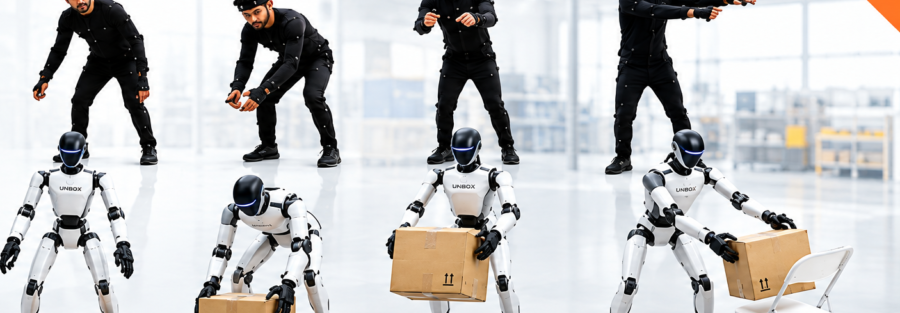
Teleoperation is the practice of controlling a robot remotely, using a human operator’s movements, gestures, or commands as the direct input. In a simple industrial robotic arm, this might mean a joystick or a handheld controller. In a humanoid robot, the ambition is much greater: the operator’s whole body motion, hand dexterity, and even the forces they feel while manipulating objects need to be captured and mapped onto a machine with a similar kinematic structure two arms, five fingers per hand, a torso, and often legs or wheels.
There are two broad reasons to teleoperate a humanoid robot today. The first is direct remote control a human pilot standing in for the robot’s judgment in a hazardous or unpredictable environment, like a disaster site, a nuclear facility, or a warehouse dock at 2 a.m. The second, and increasingly the more important reason, is data collection. Every teleoperated session generates a rich stream of paired data: what the human did, and what the robot’s joints, grippers, and sensors experienced as a result. That paired data is the fuel for training robot foundation models the large, general purpose AI systems that companies hope will eventually let humanoids operate without a human in the loop at all.
Why Data Collection Is the Real Bottleneck
It’s tempting to assume that once a humanoid robot’s hardware works, autonomy is just a matter of writing better software. In practice, the constraint is almost always data. Language models were trained on a huge, freely available corpus of text scraped from the internet. Robot foundation models have no equivalent corpus. There is no internet-scale dataset of a hand feeling the exact resistance of a screw thread, or a torso subtly shifting weight to keep balance while lifting a box. That kind of embodied, contact rich, real world data has to be captured physically, one demonstration at a time, and it is slow and expensive to gather at scale.
This is the gap Nferent AI has positioned itself to fill. Rather than building a humanoid robot of its own, Nferent operates as data infrastructure for the physical AI ecosystem running large scale capture operations that record human skill and translate it into training ready datasets for robotics and humanoid AI companies. The pitch is straightforward: robot foundation model teams are starved for real world manipulation data, and collecting it well requires specialized rigs, trained operators, and a repeatable annotation pipeline that most robotics startups don’t want to build in house.
How Nferent Approaches Teleoperation for Humanoids
Nferent’s capture stack spans several complementary modalities, each suited to a different kind of skill or fidelity requirement:
- UMI (Universal Manipulation Interface) handheld capture. Rather than requiring a full robot to be present during data collection, UMI style rigs let an operator hold a gripper equipped handheld device and physically perform a task folding a shirt, pouring a liquid, assembling a part. The device records the motion and contact data, which can later be retargeted onto different robot embodiments. This dramatically lowers the cost of collecting diverse manipulation data because it doesn’t tie up an actual expensive humanoid platform for every session.
- Teleoperated bimanual manipulation. For tasks that genuinely require two coordinated arms working together think tying a knot or assembling a multi part object an operator directly pilots a real or surrogate robotic system with both hands simultaneously, generating data on coordination and timing that single arm capture can’t replicate.
- Motion-capture gloves for hand dexterity. Humanoid hands are mechanically complex, often with more than a dozen degrees of freedom, and getting that fine motor detail right is one of the hardest problems in humanoid manipulation. Instrumented gloves capture the finger-level articulation of a human hand performing a task, giving downstream models much richer supervision than video alone could provide.
- RGB-D egocentric rigs. Wearable, head mounted or chest-mounted cameras with depth sensing capture what the operator sees from a first person point of view while they work. This egocentric perspective is close to what a humanoid robot’s own onboard cameras would perceive, which matters because it narrows the “reality gap” between training data and deployment conditions.
Each of these modalities produces a different flavor of signal coarse task structure, bimanual coordination, fine hand articulation, or visual context and combining them gives robotics teams a more complete picture of how a skill is actually performed, rather than relying on any single data source that inevitably misses something.
From Raw Footage to Training Ready Data
Capturing motion is only half the job. Raw teleoperation footage and sensor logs are not directly usable for training a model; they need to be cleaned, time aligned, labeled, and packaged. Nferent describes its process as running through three stages: comprehensive data collection across varied environments, high precision labeling to make the data machine learning ready, and delivery of ready to train datasets via API or secure transfer. This pipeline approach mirrors how large-scale computer vision datasets were built a decade ago, except now the “labels” often include continuous physical quantities like joint torque, gripper force, and pose trajectories rather than simple bounding boxes.
For a robotics company, this matters commercially as much as technically. Building an internal data-collection operation hiring operators, procuring capture hardware, building annotation tooling, managing storage and privacy is a significant distraction from the core work of building and training models. Outsourcing that pipeline to a specialist lets robot foundation model teams focus on architecture and training while still getting the volume and diversity of real world demonstrations their models need.
Why Geography and Cost Structure Matter
One detail that’s easy to overlook: where this data gets collected has a direct effect on how much of it a company can afford to gather. Data collection operations that combine manufacturing density with a favorable cost structure can produce far more demonstrations per dollar than operations run in high cost markets. That cost advantage compounds more affordable data collection means robotics teams can iterate on real embodiment data more frequently instead of falling back on simulation, which still struggles to fully capture the messiness of real contact, friction, and deformable materials.
The Bigger Picture
Teleoperation of humanoid robots is often framed as a stepping stone to full autonomy, and in a sense it is. But it’s more accurate to think of it as the training wheel that never fully comes off even highly autonomous systems will likely rely on human in the loop teleoperation for edge cases, safety overrides, and continual retraining on new tasks for years to come. Companies like Nferent AI sit at the center of that pipeline: not building the robots themselves, but building the human-driven data engine that makes it possible for robot foundation models to learn what the physical world actually feels like. As the humanoid robotics industry matures, the winners may be determined less by who has the flashiest hardware demo and more by who has quietly built the deepest, highest-fidelity well of real-world manipulation data to train on.