Robotics companies are investing in Physical AI to build systems that can understand their surroundings, manipulate objects, and perform tasks in real-world environments. However, developing these capabilities requires more than advanced robot hardware. AI models also need high-quality demonstrations that connect what a robot sees with the actions it needs to perform.
The Universal Manipulation Interface (UMI) offers an approach to collecting human manipulation demonstrations without requiring a physical robot to perform every demonstration. Its handheld gripper-based system is designed to capture information that can help train robot manipulation policies.
For robotics teams, understanding UMI hardware is only the first step. The larger challenge is collecting diverse demonstrations, validating recordings, organising data, and preparing datasets for model training.
This guide explains how UMI gripper hardware works, where it can be useful, and how specialised Physical AI data collection services can support robotics companies building data-driven systems.
What Is a UMI Gripper?
The Universal Manipulation Interface, or UMI, is a research framework for collecting human demonstrations and transferring manipulation skills to robots. The original system was developed by researchers affiliated with Stanford University, Columbia University, and Toyota Research Institute, among others.
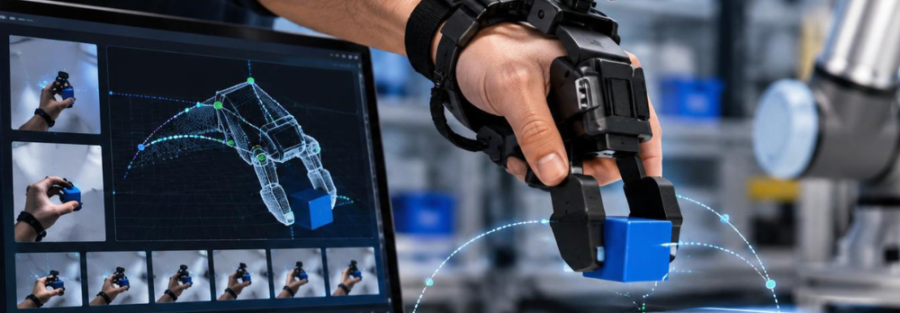
Its hardware uses a handheld parallel jaw gripper equipped with a camera. A person can hold the device and demonstrate manipulation tasks in a real environment while the system captures visual observations and action-related information.
Unlike conventional robot teleoperation, the human demonstrator does not need to control a robot arm for every recorded demonstration.
The collected data can then be processed and used to train robot policies, depending on the task, data quality, and learning pipeline.
Learn more about the original research on the official UMI project website.
How Does UMI Gripper Hardware Work?
The original UMI setup combines a handheld gripper with a camera based recording system and a carefully designed software pipeline. Each component contributes to capturing useful manipulation demonstrations.
1. Handheld Parallel Jaw Gripper
The gripper provides a physical interface for demonstrating object manipulation. A person can move the device naturally to interact with objects and perform actions such as grasping, repositioning, and placing.
This approach makes it possible to record demonstrations without requiring the human operator to control a full robotic arm.
2. Camera-Based Visual Recording
The camera captures the scene as the demonstrator interacts with objects. Visual observations help a learning system associate the surrounding environment with the actions performed.
The original UMI design also incorporates additional visual context and techniques for estimating motion, helping address challenges such as occlusion and accurate action reconstruction.
3. Action and Motion Information
Robot learning requires more than a video showing a successful task. A useful demonstration must connect observations with the movements and actions involved.
UMI incorporates motion estimation and a policy-learning interface designed to make recorded demonstrations more suitable for transferring skills to robot systems.
The exact processing pipeline depends on the implementation and intended robot platform.
How UMI Supports Physical AI Data Collection
Physical AI systems learn to interact with the physical world. For manipulation tasks, this means learning relationships between objects, visual observations, movements, and task outcomes.
UMI provides a way to collect human demonstrations that can contribute to this learning process.
A typical workflow involves the following stages:
Step 1: Define the task. Identify the manipulation behaviour the model needs to learn, such as picking up an object, arranging items, or handling objects in a particular sequence.
Step 2: Record human demonstrations. Use a suitable UMI setup to capture demonstrations in relevant environments. Multiple demonstrations may be required to represent different object positions, approaches, and task variations.
Step 3: Review and validate the recordings. Check whether demonstrations are complete, usable, and consistent with the collection requirements. Poor tracking, interruptions, or incomplete actions may reduce dataset quality.
Step 4: Process and organise the data. Depending on the project, processing may include synchronisation, action segmentation, metadata, quality checks, and dataset formatting.
Step 5: Prepare data for model training. Organise validated samples according to the requirements of the target learning pipeline. Model training and deployment remain separate steps that depend on the robotics team’s system.
This workflow highlights an important point: recording demonstrations is only one part of building a useful robotics dataset.
Why Robotics Companies Need Scalable Data Collection
A small set of demonstrations can help a team test an idea. Developing a more capable robot policy may require substantially more data across different tasks, objects, environments, and operating conditions.
As projects grow, robotics teams can encounter several challenges.
Data Diversity
A robot trained on a narrow range of demonstrations may struggle when objects, lighting, layouts, or starting positions change. Collecting varied examples helps teams evaluate and improve the generalisation of their models.
Consistent Data Quality
Incomplete recordings, inconsistent procedures, and missing metadata can make datasets harder to use. Clear collection protocols and repeatable validation procedures help teams identify problems earlier.
Data Processing and Annotation
Raw recordings may need to be organised, segmented, labelled, and converted into formats suitable for a particular training pipeline. The requirements depend on the model, task, and downstream workflow.
Operational Capacity
Managing operators, equipment, recording environments, and large volumes of files can become resource intensive. External support may help robotics teams expand data collection without building every part of the operation internally.
These challenges make data infrastructure an important consideration for companies developing Physical AI systems.
UMI Gripper vs. Traditional Robot Teleoperation
UMI and robot teleoperation offer different ways to collect manipulation demonstrations. Neither is the right choice for every project.
With UMI, a person demonstrates a task using a handheld device, allowing data collection without requiring a physical robot to execute every demonstration.
With traditional teleoperation, a human operator controls a robot remotely or through an interface. This can capture robot specific execution data and may be more appropriate when the task requires a particular robotic embodiment or control setup.
The choice depends on the project’s goals, required data, hardware, and target learning method.
For some projects, a UMI based approach may be suitable for collecting human demonstrations. Other projects may benefit from teleoperation, additional sensors, or a combination of collection methods.
Explore teleoperation data collection for robotics to understand how remote robot operation can contribute to training data.
How Nferent AI Supports Physical AI Data Collection
Collecting demonstrations is one part of building a reliable data pipeline. Robotics teams may also need help with capture planning, data validation, annotation, and dataset preparation.
Nferent AI provides Physical AI data collection services for robotics and AI teams that need real world human skill data for model development.
Depending on project requirements, support can include:
- Data capture: Collecting human demonstrations and real-world interaction data in relevant environments.
- Data annotation: Labelling tasks, actions, objects, and other information required by the project.
- Data validation: Reviewing recordings for completeness, consistency, and usability against agreed criteria.
- Dataset preparation: Organising and preparing data for integration into a client’s training pipeline.
- Capture setup planning: Identifying suitable hardware and collection methods based on the tasks and data requirements.
UMI or mobile manipulation devices may be relevant to projects that require handheld demonstration-based collection. The appropriate setup depends on the required actions, recording specifications, and target robot.
For details about available capabilities, visit Nferent AI’s Physical AI data collection services.
You can also explore its Physical AI data collection hardware and robotics data annotation resources.
When Should You Consider UMI-Based Data Collection?
UMI-based collection may be worth evaluating when a robotics project needs human manipulation demonstrations and the chosen learning pipeline can use data captured through this approach.
Potential applications include:
- Object grasping and placement
- Tabletop manipulation
- Object rearrangement
- Multi step manipulation tasks
- Demonstrations involving varied objects and environments
Suitability depends on the task, gripper design, recording requirements, and compatibility with the target robot and learning method. UMI should not be assumed to replace teleoperation or every other robotics data collection technique.
Before selecting a setup, robotics teams should define the target behaviours, expected dataset size, required sensors, quality criteria, and intended training workflow.
Build Your Physical AI Data Pipeline with Nferent AI
Developing capable robots requires data that reflects the tasks they are expected to perform. UMI provides one approach to collecting human manipulation demonstrations, but turning those recordings into a useful training resource requires a well defined collection and processing workflow.
For robotics companies, the right data strategy depends on the target application, model architecture, hardware, and deployment environment.
Nferent AI helps robotics and Physical AI teams with data capture, annotation, and dataset preparation based on project requirements.
Planning a Physical AI or robot manipulation project? Contact Nferent AI to discuss your data collection requirements and explore a suitable approach for your training pipeline.