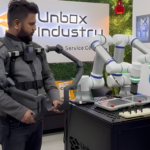
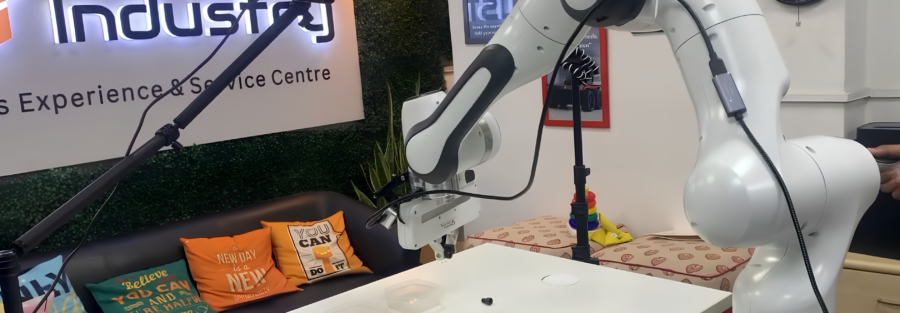
If you’ve ever watched a robot pick up a glass of water hesitate, grip too tight, and crush it you’ve seen exactly what happens when AI meets the physical world without proper training data.
Digital AI is remarkable. It reads, writes, summarizes, and reasons. But the moment you put it inside a robot arm, a warehouse picker, or an autonomous vehicle in an Indian monsoon, it falls apart. That’s because the internet the ocean of text and images it trained on has almost nothing useful to teach it about how the physical world actually behaves.
This is the core challenge of our era. And it’s precisely why building the data infrastructure for Physical AI is the most critical and most underestimated problem in robotics today.
What Is Physical AI, and Why Does It Learn Differently?
Physical AI refers to AI systems that don’t just process information they act in the world. Robots, cobots, autonomous systems, smart manufacturing lines all of these fall under the Physical AI umbrella.
Unlike a language model that learns from Wikipedia or a vision model trained on stock photos, Physical AI must understand:
- How objects move under real forces like friction, gravity, and vibration
- How materials feel the difference between gripping a soft mango versus a steel bolt
- How environments change a factory floor at 6 AM looks different from one at 6 PM with different lighting, humidity, and worker density
- How interactions cascade nudge one object, and three others shift
Text and images cannot teach any of this. Physical AI needs sensorimotor data data collected from sensors, actuators, cameras, force meters, and real-world environments at scale.
This is not a small gap. This is a foundational infrastructure problem.
The Data Infrastructure Gap Holding Robotics Back
India is accelerating fast in robotics adoption. From automotive plants in Pune to pharmaceutical packaging lines in Ahmedabad, the demand for intelligent automation is real and growing. But there’s a bottleneck nobody talks about openly:
“Robots are only as smart as the data they’re trained on and high quality Physical AI training data barely exist for Indian environment. “
Robots are only as smart as the data they’re trained on and high-quality Physical AI training data barely exists for Indian environments.
Most robotics companies globally rely on synthetic data or data collected in controlled Western lab settings. A robotic arm trained in a sanitized German factory will struggle when deployed in a Chennai warehouse with unpredictable floor surfaces, variable ambient temperatures, and a different cultural workflow pattern.
For India specifically, the Physical AI data gap means:
- Deployment failures in real-world conditions that lab testing never revealed
- Extended fine-tuning cycles that eat into ROI
- Safety risks when robots encounter scenarios they’ve never seen
- Slower adoption in sectors like agriculture, healthcare, and construction areas where India has enormous potential
Building the right data infrastructure for Physical AI isn’t optional. It’s the prerequisite for everything else.
The Data Infrastructure Gap Holding Robotics Back
What Physical AI Data Infrastructure Actually Looks Like
So what does it mean to build data infrastructure for Physical AI? It’s not a single database or a cloud platform. It’s a full pipeline:
- Multi-Modal Sensor Data Collection
Physical AI training requires data from multiple sensor streams simultaneously RGB cameras, depth sensors, IMUs, force/torque sensors, tactile arrays, LiDAR. Collecting this at scale, in real environments, with proper synchronization and labeling, is an engineering challenge most organizations are not equipped to handle. - Environment Diversity at Scale
A robot that only learns in one setting is brittle. Robust Physical AI requires data collected across diverse environments different lighting conditions, temperature ranges, surface textures, object variations, and human interaction patterns. For India, this means data from actual Indian industrial, agricultural, and logistical settings not proxies. - Edge Case and Failure Mode Coverage
The long tail of real-world scenarios is where robots fail. A dropped item. An unexpected obstacle. A conveyor belt that slows. Physical AI data infrastructure must specifically hunt for and capture these edge cases the rare events that, when they happen in production, cause the most damage. - Structured Annotation and Labeling
Raw sensor data is useless without high-quality annotation. Physical AI annotation is harder than image labeling it requires understanding 3D space, temporal sequences, physical causality, and intent. Getting this right demands domain expertise, not just outsourced clicking. - Feedback Loops from Deployment
The best Physical AI data infrastructure is not static. It includes mechanisms to capture deployment data real interactions from real robots in the field and feed that back into the training pipeline. This is how Physical AI systems get progressively smarter over time.
Why India Is a Strategic Opportunity for Physical AI Data
India is uniquely positioned to become a global hub for Physical AI development if the data infrastructure is built correctly.
Here’s why the opportunity is significant:
- Operational diversity. India’s manufacturing, agriculture, logistics, and healthcare sectors operate across wildly different environments. This diversity is exactly what Physical AI systems need to become robust.
- Scale. The sheer volume of physical operations happening across India millions of daily interactions in factories, warehouses, farms creates an enormous potential data surface.
- Talent. India has the engineering talent to build, annotate, validate, and iterate Physical AI datasets at a cost structure that makes global competitiveness viable.
- Timing. The global robotics market is growing fast. Companies that establish Physical AI data infrastructure now will have a durable competitive advantage as deployment accelerates over the next five years.
But capturing this opportunity requires deliberate investment in data collection, not waiting for it to happen organically.
What Nferent AI Is Building
At Nferent AI, we recognized early that the bottleneck in Physical AI adoption isn’t the robot hardware or the model architecture it’s the data.
We build Physical AI data infrastructure collecting, annotating, and curating real-world sensorimotor datasets so that robots can learn from the actual environments they’ll operate in.
For organizations deploying intelligent automation in India, this means:
- India-specific datasets collected in Indian environments, not repurposed from Western labs
- Multi-modal data pipelines capturing the full sensor profile Physical AI systems need
- Scalable collection operations designed to grow with your deployment footprint
- Quality-first annotation combining domain expertise with rigorous validation
We don’t just collect data. We collect the right data the kind that closes the gap between a robot that works in a demo and one that works reliably on day 300 of production.
The Cost of Getting This Wrong
Let’s be direct about what’s at stake when Physical AI data infrastructure is built poorly or not built at all.
Deployment failures are expensive. A robotic system that fails in the field costs far more than the upfront investment in proper training data. When a robot mishandles a product line, the cost isn’t just the failed batch it’s downtime, recalibration, and eroded trust in the technology.
Retraining is slow. If your Physical AI model fails because it never saw your edge cases, you’re back to data collection. Doing this reactively, after deployment, is far slower and costlier than doing it proactively at the infrastructure stage.
Competitive timing matters. In the next 24 months, the organizations that build robust Physical AI will establish significant operational advantages. Those waiting for the data problem to solve itself will find themselves far behind.
Building for the Real World
The next wave of robotics won’t be won by companies with the best hardware or the most sophisticated model architectures alone. It will be won by the companies that figured out how to train their systems on data that actually reflects the messy, variable, unpredictable real world.
Building the data infrastructure for Physical AI is that work. It’s not glamorous. It doesn’t generate as many headlines as a new robot demo. But it is the foundation on which every reliable, scalable, commercially viable intelligent machine will be built.
India has the environments, the scale, and the talent to lead this. What it needs is the infrastructure.
That’s exactly what we’re building at Nferent AI.
“Interested in Physical AI data infrastructure for your robotics deployment in India? Connect with the Nferent AI team at nferent.ai“